I always buy annuals early, favorites and the more unusual varieties are gone by mid April.Since I’ve had terrible luck starting cosmos from seed, my only alternative is to buy a flat or two.Didier greenhouse grows a very limited number, so I grab them the minute they become available. I was never able to find any yellow or orange cosmos but love these pink.
Plum Crazy is my favorite petunia color. It sells out pretty quickly too so I pick mine up early. Our last frost date is May 15th so plants, in their tiny cell packs, must be babied along until they can safely go into the garden.
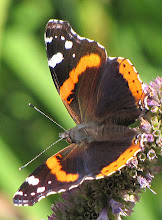
I spent more than half an hour hovering around the flats of annuals and hoping this red admiral butterfly would land on one of the blooms and let me get his photo against a pretty background.
He was determined not to cooperate.He spent his time sunning on the ugly brown leaf mulch, on the concrete driveway, and on a torn dogwood leaf. He never went near the flowers.
Last year was so wet we saw almost no butterflies until August. This year is the opposite, very dry so butterflies are out early.
In addition to the lilacs and flowering fruit trees, viburnum x Burkwoodii is in bloom. This is the first viburnum to flower here.It isn’t the showiest but it has a strong, sweet fragrance.
While I work outside, Toby patrols, keeping me safe from marauding mice and gophers.
Shakespeare's quote seemed apt, our weekend was full of sound and fury as thunderstorms passed over us pushed on by 50 mph winds. Unfortunately we received almost no rain.
This morning the television news is full of stories about the torrential rains and flooding in Tennessee. My heart goes out to all the families caught up in this disaster. This morning I'm hoping our Tennessee blogging friends are online to let us know they are OK.
A few weeks ago I enjoyed seeing photos of cherry trees blooming south of here. So far, I have never been lucky enough to visit DC at cherry blossom time.
For the last three weeks northern Illinois has been blessed with a stunning display of crabapple blooms.
Driving around town, running errands, I snapped a few photos I hope you will enjoy.
I may be prejudiced, but to me, our crab apples look every bit as beautiful as the cherries. They bloom in every shade from pure white to almost red.
This year has been a great year for the crab apples. They like cool, sunny weather and we have had an abundance in April.
Thursday, April 29, 2010
I have never had so many good ideas day after day as when I work in the garden. ~John Erskine
At 6:30 Wednesday morning I picked an armful of lilacs to bring to work.My fingers were stinging from the frosty air as I cut the woody stems and stuffed them into a pail of water.It was a beautiful morning and even though a fine film of frost lay over everything, the clear sunshine and vivid colors couldn’t help but lift the spirits.
Something that always strikes me on cold mornings when the temperature is below freezing is that even lilacs have no fragrance.An hour after being placed in the warm offices the lilac scent is heavy throughout the building.For me, the fragrance is the best thing about lilacs.They are lovely to look at but noting compares to walking into the garden on a spring afternoon and smelling that teasing scent on every stray breeze.
Perhaps one of the most appealing things about gardening is that simple chores free the gardener's conscious to float out over a strange array of subjects.Outside in the fresh air, the mind is swept clean and tends to wander down seldom used thought paths.
I have some happy news.My father finally came home from the therapy center Tuesday.I can’t tell you how much the family worried about this event.We weren’t sure he was up to living without skilled help and supervision.At Cor Mariae, Dad seemed so helpless and frail, but home on his own turf, he has made a miraculous change.He was in and out his back door a dozen times just sitting in the sunshine and walking slowly along the edge of his woodland garden while one of us told him what was blooming and tried to make word pictures he could ‘see’ in his mind.
Thank you everyone for your good wishes and kind comments about Dad while he was so sick.
Monday, April 26, 2010
I will be resuming twice weekly publishing starting today. I will try to maintain a Monday and Thursday schedule of posts.
I want to thank everyone who stops by even when plants in the garden are scarce. I can't tell you how much your comments and advice are enjoyed and appreciated. You have become very good friends over the seasons and I treasurer the time we spend sharing stories and photos.
Really looking forward to this season in the garden. Hoping for good weather and plenty of rain.
******
Tulip season is winding down. First the little species tulips bloomed with the daffodils. Next came the parrots and now the late doubles.
Late doubles are first.
Allegretto is a fire storm of color. This is one of those 55 mph tulips, as Brent and Becky's call them, a real standout. It was the last tulip to bloom so it may have a week or more before it's finished.
Toning down a few shades is Foxtrot a multi hued pink double.
And last, everyone's favorite late blooming double, the lovely Angelique. Angelique has been extremely long lived here. Every year I breath a sigh of relief when I see her foliage emerge and know she has come back once again.
Now the flamboyant parrot tulips. Below is Libretto, very similar to Madonna (Madonna can be seen on my header and in the previous post) but with a much less dramatic green flame. Libertto blooms about two weeks later than Madonna in my garden.
Opening wide during the day to allow the pollinators access and closing back in the evening.
This is Carmine, outrageously beautiful.
Now for a few blooms from the shade and woodland gardens.
I'm smitten with lamium Pink Pearl. The pearly silver and green leaves almost glow in a shady spot. It's a quick spreader so I'll be dividing and moving this clump around very soon.
These are Virginia blue bells and I can see a couple leaves of garlic mustard among them. How embarrassing, we all have weeds but we don't usually show them off! Garlic mustard is the bane of my existence. Hope you never get this evil weed in or around your property.
Saving the best for last. Isn't this just the loveliest and most romantic of plants. My father has two varieties, one like this and a more or less ever blooming cultivar. The ever bloomer does not have quite the perfectly defined heart shape and the color is pale but the foliage is ferny and very attractive.
Last weekend's sun rises behind promising clouds but the promise never materializes. The clouds burn off later in the day and we still have no rain. The ground is very dry and the wind is constant. My woodland garden is quietly suffering.
Still hopeful that some rain my drift our way by week's end.
Anyone who says sunshine brings happiness has never danced in the rain.
~Author Unknown
The celandine poppies are beginning to bloom. To think, once not long ago, I did not like these plants.
Confederate violets are more persistent than the common lawn violets. To have one today is to have several hundred in a few years.
Couldn't resist these fringe tulips when I stopped at Didier's. Don't look too closely or the fringe begins to look like sharp white teeth.
Virginia blue bells blooming in a little pool of anemone.
Anemone is another plant I never cared much for until recently. It seemed so bland. Now I can't grow enough of it. My ideas about flowers and gardens have changed drastically over the years.
A large spot of whimsy I pass on the way to visit my father at the therapy center. This 15-foot tall tree has been completely uprooted and 'planted' upside down with the roots making a large nest at the top. It is decorated with bright spring colors.
The Resident Rodent Remover is on the job. Wearing his fearsome expression, doesn't he remind you of Clint Eastwood? No need to worry about moles, voles or gophers in his gardens.
An interesting bit of trivia. Last month was the warmest March in history, globally.
Our temperatures are still way above average. Eighties today and tomorrow before a cold front comes through and brings rain and cooler weather.
I took photos of my spring bulbs last night. These eighty degree days may spell an end to the bulb season. Fingers crossed that the cooler weather on Friday will rescue some of them.
My favorite Parrot Tulip came back--second year in a row. The color combination is fantastic.
These very short yellow and red tulips are Kaufmanniana Guiseppe Verdi. Very short with some red striping in the foliage.
Another very short tulip is Greigii Orange Toronto only about 10 inches tall with very nice red striped foliage.
Unknown daffodil, little faces turned toward the sun. Love the bright colors.
This daffodil reminds me of eggs, the center looks like yellow yolks;) Very small blooms but ruffled and pretty.
Another of my Parrot Tulips.
Do any of you dig your tulip bulbs after the foliage dies back? I've heard some people have success doing this to keep the bulbs going from year to year. A little extra trouble, but I would do it for favorite varieties.
Wednesday, April 7, 2010
Though a country be sundered, hills and rivers endure; And spring comes green again to trees and grasses Where petals have been shed like tears And lonely birds have sung their grief. ~TuFu
A lovely week past with temperatures ranging from the 70's to a record breaking 80+. Overnight the bulbs shot up inches and these daffodils burst into bloom. Signs of spring are everywhere. The grass is greening and will need a first mowing soon (my least favorite summer chore.) The first toad of the season hopped across my path late Monday evening and was almost stepped on, accidentally of course. They seem to like to hang out in front of the garage so if I manage to miss them with the car wheels, I may stumble over one in the dark. At night I hear the lovely music of the frogs and during the day the birds are full of spring songs .
This year plants are about two weeks ahead of the season. I checked the posts from 2009 and the little group of daffodils pictured here bloomed April 20th.
Last weekend brought gentle rains and now midweek, we are having thunderstorms. Thunderstorms are another sure sign of spring but, an interesting note, we had thundersnow a couple times over the winter. Temperatures are expected to plunge, today's highs will be in the 40's with a possibility of a little snow tonight. As much as I enjoyed the warmer temperatures, my flowers will actually last much longer if the weather is cool. Tulips especially seem to blow in a day or two of 70 degree heat.
This forsythia is not mine but I wish it were, it certainly is lovely.
The geese are seeking solitude to nest and raise their young. I knew that geese mated for life but did not know that they stay in family groups (even in a large migratory flock family members will remain close to each other). If a goose gets injured and cannot keep up with the migratory flock, it will land, often with family members. These geese will stick with the injured one until it gets better or dies, and then join a new flock.
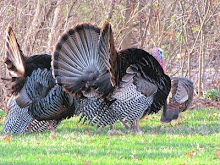
Turkeys on the other hand are polygamists and seduce as many ladies as they can.
Turkeys and geese nest on the ground and require abut 6 weeks to lay and hatch their eggs. During this time they are very vulnerable to predation. It's estimated that less than half of nestings result in live chicks. After that the mortality rate increases and only 20 or 30 percent of the chicks reach an age when they can fly.
These photos don't show the lovely iridescent colors of their feathers. Groups of wild turkeys are becoming quite common in this area. Hopefully some chicks will soon appear following close behind their mamas.
Now that the winter’s gone, the earth hath lost Her snow-white robes; and now no more the frost Candies the grass, or casts an icy cream Upon the silver lake or crystal stream: But the warm sun thaws the benumbed earth, And makes it tender; gives a sacred birth
**********************
Some of you may have seen this going around in emails. I got such a kick out of it I wanted to post it for anyone who hasn't seen it yet.
How much does a house weigh?
How much weight can a two lane rural bridge hold?
Is this covered by my homeowners or vehicle insurance?
Finally we have a week of beautiful weather. I tiptoe around the edges of the garden. I’m bent over, peering down, looking for signs of green, brushing away a little leaf mulch and then putting it carefully back. I have to time my garden activity perfectly. If mulch is raked away too early, it won’t protect the tender shoots from late frost, but if left too long, there could be injury to the new plants it protects. When the forsythia bloom is the general rule here. Cut back perennials, prune roses and remove mulch when the forsythia begin to flower. (Southern gardeners are probably wondering why anyone would try to garden in a place where the last spring frost date is May 15th:)
Every spring I regret not planting more very early bloomers like hellebore and crocus. It’s the high failure rate that always makes me hesitate. More often than not, early flowers are either buried under several inches of snow or ruined by hard freezes. The failure years always seem much harder than if I had nothing at all to anticipate.
I’m surprised to see how dry the upper layer of soil is. After the abundance of snow that just melted, I expected the ground to remain wet longer. Rain is predicted for this weekend and we really need it to give plants a good start.
The lamium leaves are limp but still hold that pretty green and white pattern. Lamium tries to be an evergreen, remaining leafed out all winter, protected by the snow. Strawberries too and heuchera keep their foliage. I’ve seen early daffodils blooming in other gardens but mine are way behind. Some of the distinctly striped species tulip foliage is showing--not much. I planted a dozen or more bulbs last fall and not nearly that number has emerged. Disappointing.
The pagoda dogwood leaf buds are swelling and the lilacs are just forming flower buds. Spring is always cautious in the north. In May the earth will explode, making up for time lost.
This is Hocus Pocus, the perfect friend to share a comfy chair or a pillow with while reading a good mystery.
Hocus and I recently spent a day reading The Crossing Places, a first novel by Elly Griffiths. Since my garden updates are so pitifully brief, we decided to include a book review. (Really, it was my decision, Hocus had no opinion either way. Another reason to love cats, they never argue:) My review follows.
Round the eastern coast of Norfolk, the North Sea creeps upon the land and leaves behind a desolate place known as the salt marsh; a landscape of oozing mud and deep pools hidden beneath rampant grass and reeds. Thousands of years ago, this hostile place may have held religious significance for primitive peoples. Upon it they built a wooden henge and set markers to navigate the quicksand beds.
Today, this lonely site is shunned by most, but Dr Ruth Galloway chooses to live here near where she first excavated the site of the ancient henge. Dr Galloway, archaeologist, anthropologist, and professor at Northern Norfolk University, views the salt marsh with a strange combination of fear and awe, love and loathing. Although the road to her cottage, one of only three houses on the marsh, is frequently flooded and impassible, she is determined to ignore these inconveniences and remain living with the history of the long ago people who dwelt here.
Her anthropology expertise makes her the logical person to consult when the shifting bog gives up the body of a child. Could this child be Lucy Downey, taken from her home ten years ago with never a trace or clue to her fate? The missing child has haunted Detective Chief Inspector Harry Nelson these long years. After the child went missing, the kidnapper taunted him with letters giving cryptic clues to Lucy’s final resting place. A brief examination by Dr Galloway results in the discovery of an Iron Age torc around the child’s neck and she determines this is not Lucy but rather an amazingly well
preserved corpse that dates to perhaps 600 BC.
Another crushing disappointment for DCI Nelson, but a career building discovery for Galloway. Still, the Inspector senses an ally in Ruth. Her ready knowledge of folklore and ancient myths may aid him in discovering clues in the letters written by the kidnapper (if they were indeed written by him and not some publicity seeker trying to gain attention from a high profile case). Thus, Ruth is drawn into the search for the long missing Lucy and her abductor.
Author Elly Griffiths creates a vivid picture of this desolate bog, a place of neither sea nor land that holds many secretes and must be coxed into revealing them. The British have a knack for writing dark and brooding atmosphere. I have a feeling that we Americans would look upon this place as a mostly sunny wetland full of wonderful birds and colorful plants, but that would not add to the sinister tone of the story. Instead, Griffiths paints us a landscape, lonely and unfriendly, dark and wet and always willing to
accept the sacrifices of man and hold them forever.
Ruth Galloway is an unusual main character. Neurotic, aging and overweight, struggling with a lot of anger and self worth issues, she isn’t at first a very likable heroine. We glimpse her thoughts and see mostly self absorption and repressed hostility. It was not Ruth’s character, but rather the romance of ancient legends that pulled me deeply into the story. DCI Nelson is a more compelling character. He is both intense and focused and the reader can’t help but sympathize with his frustration over his failure to resolve the
Lucy Downey case.
Familiar as we are here in America with police procedurals (we are bombarded by forensic shows such as CSI, NCIS and Law and Order) we may also wonder why the Norfolk police didn’t call in experts in the fields of mythology and religion to analyze the letters at the beginning of the abduction case rather than ten years later. All I can say is that most novels have these irritating flaws but if the author has already hooked her readers, minor problems can be overlooked.
For years I have been an avid reader of the novels of Beverly Connor and Kathy Reichs, both anthropologists. Elly Griffiths’ first novel The Crossing Place is different even though the theme is similar. Slower paced and featuring not the self assured professional women created by the first two authors, but rather a competent academic who is more comfortable with cats than police inspectors and who, every morning must deal with her own self image before she can face the challenges of the day.
This book lost points with me for the following reasons:
Animal cruelty. I know it’s just a book, but the cruelty was senseless.
Too much angst and self-absorption.
The ending was just too well tied up. All the puzzle pieces fell in place much too quickly and too perfectly.
I knew who the evil doer was from the beginning (but there were a few surprises in the red herrings Griffiths threw at us).