Thursday, May 21, 2009

Showcasing two old fasioned bloomers


These two shrubs were in my parent's and my grandparent's gardens. Old fashioned, carefree and as dependable as great grandpa's pocket watch. Both are out of style now, replaced by newer hybrids with more color and longer bloom time. Still, I wouldn't be without these old faithful garden friends.

Bridal wreath spirea (Rosaceae spireae prunfolia) is lovely in bloom. The bush is fountain shaped with arching branches accented by thousands of clumps of tiny white flowers. I have a preference for gracefully arching branches so it is very appealing to me.


Other big advantages: In my garden this spirea has no pests and no disease. It is tolerant of poor rocky soil, extreme temperatures, light shade and drought.

Everybody just calls the second shrub "the snowball bush". Viburnum opulus has a short window of display time before it becomes another featureless upright shrub. For the brief period when it is covered in big balls of white it is a traffic stopper. I wish this viburnum produced colorful berries to give us another season of interest but alas it does not.


The snowball bush is another no problem bloomer that requires little maintenance and is forgiving of cold, heat and drought. I've heard people complain about aphids but on my farm the lady bug population far outnumbers the aphids.

Unfortunately this is not one of the wonderfully fragrant viburnums but you seldom get all the best options in one package.


Pruning about one third every other year works well for me and results in more blooms and better shape the following spring. I prune both shrubs in late spring soon after bloom.


~ ~ ~ ~

Wildlife Rumors by Miss B


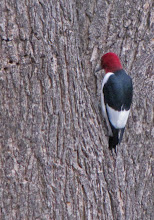
Late breaking news has set this community on its ear. Red Headed Woodpecker was seen at the Maple Tree Restaurant eating a suet and sunflower dinner. Red has never visited us before but his reputation proceeds him. It seems this bad boy has a not-so-stellar-reputation. Claims from other communities describe him as a thug, vandalizing homes, breaking eggs, and worse.


Red told our reporter Miss B that these allegations were scurrilous lies and that he was simply a peace loving woodpecker doing good deeds by removing insects from the environment.

The morning after Miss B interviewed Red, he left the area and the bird population breathed a sigh of relief.

Crime is on the rise in the community since the arrival of the Raccoon family. Described as bandits, these renegades allegedly prowl the area at night holding up restaurants and eating everything in sight. It is even believed the Raccoons are responsible for Mr and Mrs Towhee leaving the area. So far police have not been able to catch them in the act.

Miss B will have more news as it breaks.


Onions and grape-ade


The delicately beautiful blooms of the iris are deceptive. There are few plants in my garden as tough as the tall bearded iris. The white iris Immortality is the first to bloom. Last year the black iris Superstition bloomed at almost the same time for a wonderful color contrast.

I can count on iris to do their thing every year with no help or coddling from the gardener. In fact they are so self sufficient I force them to endure conditions they shouldn't have to put up with. In some areas of my garden they are rediculously overcrowded. They get no supplemental water even in times of drought nor are they fertilized or fed. They do well in a naturalized area and hold their own against the grasses and tree roots. They are never harmed by late spring freezes but severe rain storms occasionally make the bloom stalks tilt at crazy angles. The downside is a very short bloom time but the spiky foliage alone is not unattractive. Most of my iris have a delicious grape-ade fragrance.

This year allium (a member of the onion family) "Purple Sensation" is blooming at the same time as the Immortality iris. I find these tall purple orbs on the end of a slender stick a little difficult to incorporate with other plants. The color is nice on these alliums but they would look much better at half the height. "Purple Sensation" does reseed and many clumps of grass like young folliage are scattered through my garden. It will probably take these seedlings three or four years to reach maturity and bloom. Purple Sensation blooms for about two weeks but I allow the interesting seed headto remain for months.

(The sun just rising behind the a group of iris and allium.)


Another allium planted in my garden for the first time in the fall of 2008. This is Allium karataviense a very low growing plant for the front of the border. The leaves are interesting and attractive in the early spring. Later three inch oval blooms nestle down low in the leaf cup. I hadn't seen karataviense widely available and reasonably priced until last fall. There is also a wine and pale lavender colored variation that make an interesting addition to the garden. See Tina's "IN THE GARDEN" post for more info and photos on alliums.


Above white blooms and below pale lavender. My plants were purchased as "Ivory Queen" but obviously are not.

After doing some additional research I learned these allium do reseed freely. Since it takes several years for seed to produce a flowering bulb most people will probably want to just purchase mature bulbs and not expect much from seedlings.


Wildlife Rumors by Miss B


This breaking headline just in from our reporter Miss B.

Trouble in the local monarchy. Monday one of the young princess bees, tired of waiting for the Queen to die, gathered her loyal followers and left the hive. The old queen was sorry to see her subjects leave but made no attempt to stop them. This is not the first uprising in this hive. Over more than 20-years many such defections have occurred.


Hundreds of servants gathered round the new queen on a flimsy tree limb while scouts were sent outside the realm to seek a suitable location for a new hive.


Best of luck your majesty as you and your followers under take this perilous journey.
May you find your Camelot.

Long live the Queen.

Tuesday, May 19, 2009

Then and now plus Wildlife News from Miss B


These lovely blooms are already fallen. There was such an abundance of flowers in May that I couldn't squeeze them all into my twice weekly blog schedule. Still, I could not completely ignore the beauty of the crabapple blossoms. They deserve mention and a photo or two. They bloomed a week or two before the lilacs this year and like the lilacs their time is very brief. Neither the lilacs nor the crabapples have much to recommend them during the 51 weeks of the year when they aren't blooming. We gardeners put up with straggly bushes and problematic trees for just that one glorious week that makes them worthwhile.


These garish tulips are still blooming. It's been a very cool and rainy spring and my bulbs have bloomed for weeks. Nepata is beginning to flower in the background.


A very late blooming daffodil.


This delicate geranium is restful after the hot reds and yellows of the late blooming bulbs. The name geranium is from the Greek geranos (crane) that referred to the long crane-like beak of the seed pod. Some are called bloody cranesbills because the foliage turns bright red in autumn.


~ ~ ~
Wildlife rumors by Miss B


This story just in from our intrepid gossip columnist Miss B.

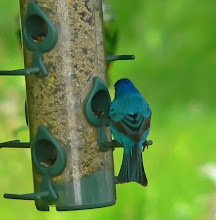
Mrs Rose Breasted Grosbeak has been seen at a trendy, upscale restaurant dining with the handsome Indigo Bunting. Neither Rose nor Indigo would give our reporter a comment.


Later that evening Mr. Rose Breasted Grosbeak was seen dining at the same restaurant--alone. Are the Grosbeaks calling it quits? Has Rose really dumped Mr G and run off with the handsome Indigo? A spokesman for Mr. Grosbeak denies these rumors saying the three are just very good friends. Our reporter Miss B will have updates as more news breaks.


Please stop by Rambling Woods Nature Notes for more birding and wildlife discussions.


Monday, May 18, 2009

Lilacs in dooryards holding quiet conversations with an early moon

Every old house and farmstead in Illinois and Wisconsin has lilacs. A hundred years ago women picked arms full of lilacs to brighten their drab kitchens. Fifty years ago families sat on their porches on fine spring days and enjoyed the scent of lilacs all around them. As a child, spring lilac blooms always graced our kitchen table. I carried bunches tightly clenched in my little fists to grade school teachers. In later years, a vase sat on my nightstand perfuming my bedroom. Today lilacs sit on my desk at work. A bit of my garden carried with me to this sterile place.

A few lines from Amy Lowell's poem. Read the rest at Amy Lowell Lilacs

Your great puffs of flowers
Are everywhere in this my New England.
Among your heart-shaped leaves
Orange orioles hop like music-box birds and sing
Their little weak soft songs;
In the crooks of your branches
The bright eyes of song sparrows sitting on spotted eggs
Peer restlessly through the light and shadow
Of all Springs.
Lilacs in dooryards
Holding quiet conversations with an early moon;
Lilacs watching a deserted house
Settling sideways into the grass of an old road;
Lilacs, wind-beaten, staggering under a lopsided shock of bloom
Above a cellar dug into a hill.


(Common Lilac pale lavender)


(Agincourt Beauty a very dark redish purple)


Short poem by 16 year old oceanreverie

sunlight pours in as waves
gently caressing my face
the symphony of cars on gravel
birds serenading from their branches
a cool breeze through the trees
fills my cluttered mind
i throw back the covers
and step towards the open window
and smell lilac;
sweet and innocent
drifting in to greet me
this morning
is beautiful
a taste of something new
of something life-changing
so i'll walk outside
and cut a bit of lilac
of beauty
to hold throughout the day
so i'll remember
today is an open window
by oceanreverie
05/07/2008

~ ~ ~ ~ ~ ~


I'll close with more photos of squabbling finches at the sock feeder. It's easy to attract goldfinches to your garden by adding one of these socks full of nyger thistle seed. (Nyger is sterile and will not sprout in your garden;) Everyone, have a great day.

Thursday, May 14, 2009

Shade lovers and wild flowers

The same leaves over and over again!
They fall from giving shade above
To make one texture of faded brown
And fit the earth like a leather glove.

Before the leaves can mount again
To fill the trees with another shade,
They must go down past things coming up.
They must go down into the dark decayed.

They must be pierced by flowers and put
Beneath the feet of dancing flowers.
However it is in some other world
I know this the is way in ours.

~ Robert Frost


A few more plants from my shady nook under the lilac hedge.

Large flowered Bellwort or Merry Bells (Uvularia grandiflora) is an undemanding plant that adds a dainty hint of yellow to the spring shade garden. The growth habit is dense and rounded about two feet tall or less. I make sure to incorporate lots of compost into the soil to keep these plants content. (I really hate to mention compost when I'm posting about lovely blooms. Ah, the romance of compost. Getting our hands dirty in order to enjoy the spoils of leaf mold is just something we gardeners must accept. I absolutely will not discuss well rotted manure here;). The scientific name comes from ' the flower hanging like the uvula' (that thing in the back of your throat). I hate botanical names.


(Stylophorum diphyllum) Celandine Poppies spread freely around my shady garden. Reseeding can become a chore but they aren't especially hard to control. The bright splashes of gold are well worth pulling a few errant seedlings. The foliage is attractive and in places where it is happy, it blooms off and on all season. During drought conditions it becomes dormant mid summer. Beware if you have deer, these are one of their favorite horsdeuvers. No other pests or disease.


Woodland phlox or wild Sweet William (Phlox divaricata) displays beautifully in light or high shade areas. It looks especially nice as underplanting for taller plants like bleeding heart, celadine poppies, geraniums and hostas. There is some color variation within the species. Mine are almost the same shade of lavender as my old fashioned lilacs. A nice combination since they bloom about the same time each year. Newer cultivars are bluer. Butterflies and bumble bees love them (they have a nice fragrance if you get down on your knees and stick you nose into a clump;). Wirey stems and foliage try to remain evergreen here. Some gardeners have problems with mildew, so far I've been fortunate and had no problems.


Note: I name the genus and species whenever I remember but I'm not fond of botanical names (perhaps I've mentioned that) and usually avoid them. I love the romance of the common old names. Flowers are beautiful and they deserve charming, descriptive names that convey their history. The argument goes that common names are vague or may apply to more than one genus or species. That has not been my experience. For gardeners who become confused, the cultivar name is usually what is needed.

I'm probably in the (vast) minority but how do you feel about botanical names?

Monday, May 11, 2009

Shady Garden beneath the lilacs

Falls the weird spirit of unexplained delight,
New mystery in every shady place,
In every whispering tree a nameless grace
~ C S Lewis


Today the Bleeding Heart is my favorite flower. Such a fanciful bloomer with graceful arching branches and delicate color. Common Bleeding Heart (Dicentra spectabilis) is a native of Asia from Siberia to Japan. This is the species most often seen in gardens. It does very well in the semi shade of my lilac bushes. Planted in compost enriched soil with lots of leaf mulch added every year it has been unaffected by drought, heat, cold or any insect pests. It will die back by mid summer so I've planted hosta and other shade lovers near by to limit the the hole in the garden.


Fringed Bleeding Heart (Dicentra eximia) is native to the woodlands of the Appalachians. It is a smaller plant less than two feet tall in my garden and the foliage is deeply cut and fern-like. It seems to have a longer bloom period and does not disappear during the warmer months. The blooms are paler, a little differently shaped and they do not have the wonderful arching habit of spectablis. This plant does quite well in full sun in my father's garden.


Alba is a pure white blooming variety of the common bleeding heart. It makes an elegant and graceful presence in a shady spot. I don't have this one yet but perhaps will add it soon.

These plants will not tolerate poor drainage and will self sew in perfect conditions.


Thursday, May 7, 2009

When tulips bloom

The day is fresh-washed and fair,
and there is a smell of tulips and narcissus in the air.

~ Amy Lowell


(Above double tulip Angelique, in my opinion one of the best and longest lasting tulips. This one has come back for five years but that is rare)


Below Henry Van Dyke's poem: When Tulips Bloom (1894) illustrated with photos from my garden.

When tulips bloom in Union Square,
And timid breaths of vernal air
Go wandering down the dusty town,
Like children lost in Vanity Fair;

When every long, unlovely row
Of westward houses stands aglow,
And leads the eyes to sunset skies
Beyond the hills where green trees grow;

Then weary seems the street parade,
And weary books, and weary trade:
I'm only wishing to go a-fishing;
For this the month of May was made.

I guess the pussy-willows now
Are creeping out on every bough
Along the brook; and robins look
For early worms behind the plough.


The thistle-birds have changed their dun,
For yellow coats, to match the sun;
And in the same array of flame
The Dandelion Show's begun.


The flocks of young anemones
Are dancing round the budding trees:
Who can help wishing to go a-fishing
On days as full of joy as these?

I think the meadow-lark's clear sound
Leaks upward slowly from the ground,
While on the wing the bluebirds ring
Their wedding-bells to woods around.

(Photo from my father's neighbor's home. I thought the hollow stump was so charming.)

The flirting chewink calls his dear
Behind the bush; and very near,
Where water flows, where green grass grows,
Song-sparrows gently sing, "Good cheer."

And, best of all, through twilight's calm
The hermit-thrush repeats his psalm.
How much I'm wishing to go a-fishing
In days so sweet with music's balm!

'Tis not a proud desire of mine;
I ask for nothing superfine;
No heavy weight, no salmon great,
To break the record, or my line.

Only an idle little stream,
Whose amber waters softly gleam,
Where I may wade through woodland shade,
And cast the fly, and loaf, and dream:

Only a trout or two, to dart
From foaming pools, and try my art:
'Tis all I'm wishing--old-fashioned fishing,
And just a day on Nature's heart.

~


(Wild plum blossoms bloom in the hedgerows around the farm.)

~~~~

Are any of you mushroomers? Is this a morel. I have dozens growing around a dead tree on the farm. I'm afraid to eat anything I'm not 100% certain is not poisonous.


Monday, May 4, 2009

Parrot tulips


Parrot Tulips, the photos tell the story. These are probably my favorite tulips.

Opening late in the morning for pollinators.


Closing back up at night.


Parrot Tulip Madonna


Goldfinch eating nyjer thistle seed on flowering amalanchier. The seed is sterile so you don't need to worry about a crop of thistle sprouting in youR yard.

Thursday, April 30, 2009

Visiting greenhouses and garden centers

and helping the local economy;)


I love visiting the greenhouses, garden centers and even the box store's garden sections. It's fun looking for new things and finding old favorites to bring home.

Yesterday afternoon I made the rounds. Starting at Menards, which is closest, I found a couple good buys. First a tiny hosta named Blue Mouse Ears. Who wouldn't love a plant named mouse ears? I haven't added a hosta to my garden in years because of the virus problem but I decided to put this little fellow in an isolated spot where it has no contact with my other hostas.

Next I found purple garden phlox, two for $3, can't beat that. Finishing up with a few annuals and I was off to my next stop.

Home Depot, their plant selection was disappointing but I did pick up a new pair of pruners. Pruners are more or less disposable items to me. I lose them. Last year John Deere found two of my pruning saws. What a mess. I haven't seen my bypass pruners in quite a while. Maybe John will find them too. I need to paint these new pruners 'dayglo' orange before I ever take them out of the house.


(In the box phlox, caladium, sweet potato vine, annual geranium 'Jewel')

Didier Greenhouse has been here since before I was born. It's always been my favorite and it never disappoints. They have both the usual and the unusual and their plants are in top condition. My best find at Didiers was Victoria salvia, huge pots blooming and extremely healthy. I set the pots out in my garden to judge their impact in several locations.


(Victoria salvia in big pots)

I haven't tried Victoria before but they look like they could become a favorite. Lots of you bloggers have mentioned them favorably on your sites.

Next I found some deliciously colored petunias for ever blooming accents in pots and between perennials. I passed the Lady in Red salvia which was a mistake. I will definitely go back for that one.


They had lots of tomato plants , even a few heirlooms so I added two Mortgage Lifters and a Rutgers.

Feeling very pleased with myself I loaded up the trunk and headed home. I have several other garden centers to visit but that will be another day.

Now comes the hard part. Except for the phlox and the hosta, none of these plants can be put into the garden or even into heavy containers until after the last frost date, May 15. That means constant watering and tending. I also foresee a lot of dragging them into and out of the garage on cold nights. It will be worth the extra effort to finally have some color even if it's only sitting in a box on the driveway;)


It's been a pretty good season for daffodils. The temperatures have been low and the rain plentiful. The plants below have kept their color for quite a long period but are starting to fade.

Most of the daffodil bulbs were added to the garden last fall. Next fall I hope to find a wider variety to include for next spring's bloom.