Monday, September 8, 2008

Have some fun with your pictures, try Frame Fun

I was going to do a story about Tempest the border collie today. I changed my schedule since many people asked about the frame on Friday's sunrise photo (well, maybe not many people, one or two people might have mentioned it). Anyway, I'm preempting Tempest. Her story will appear in a day or two.

If you like pictures and you enjoy playing on the computer, you might enjoy Framefun v 2.0.0.7.
This program can enhance your photos, make them stand out, and create more of a professional effect. Of course you can create frames in Photoshop, but this program takes about one tenth the time and effort.

This is a very small, simple program that creates frames or borders for your photographs. Wide or narrow frames in a big selection of colors. It can mat your pictures too giving you a double border. By selecting the shadow option, you get a 3-d effect like a picture stuck on paper. You can write notes or titles on the mats for a professional look (you will need another program to write on photos). This is a quick and easy way to give your pictures just a little added style. And it's fun.

Here are a few examples:

First a screen shot of the program. Bottom left select frame, the color and the size. In the center you can check the border selection (like a mat inside the frame) and choose a color. You can try the vignette and the oval choices to see if you like those effects. If you want a shadow, you can do that too in several sizes and shades. Click apply. If you don't like the result, change the sizes, colors, etc and just click apply again.
The program is fast and takes up very little space on your hard drive. It's also intuitive so there is no wasted time learning complicated procedures. Run a picture thru more than once and build on the number of borders. The best thing about Framefun, it's free.

Below is a simple black frame with a wider white border and shadow.
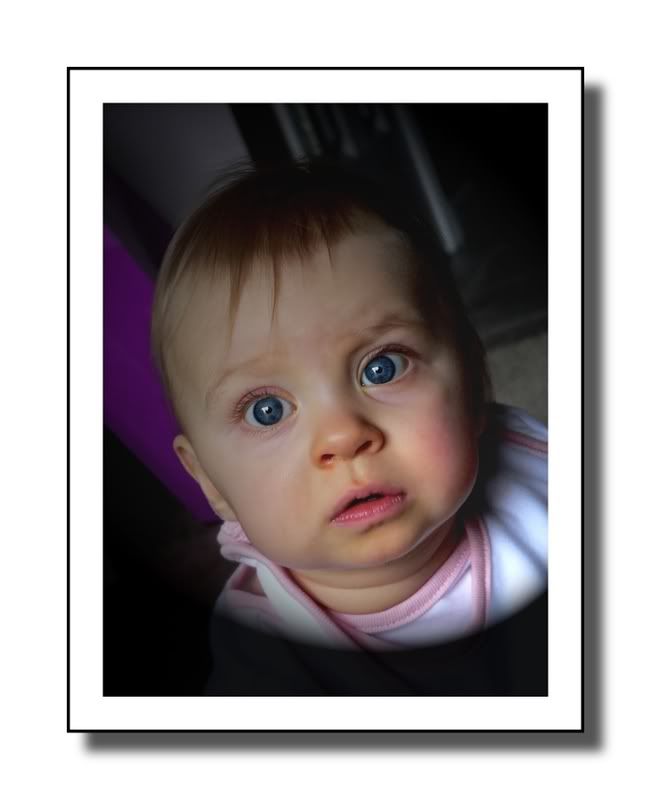
The same photo with an oval white frame.
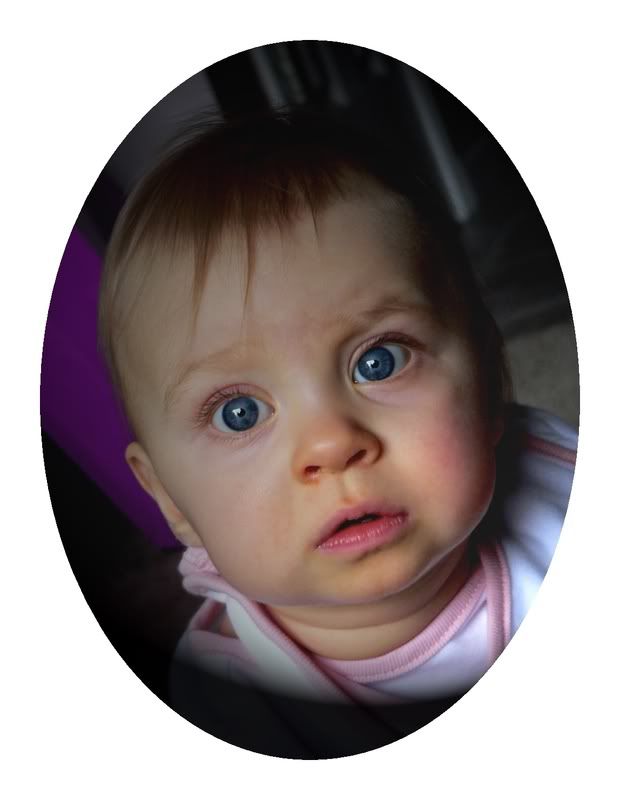
I ran this photo thru twice. A white frame inside and then a green frame and white mat.
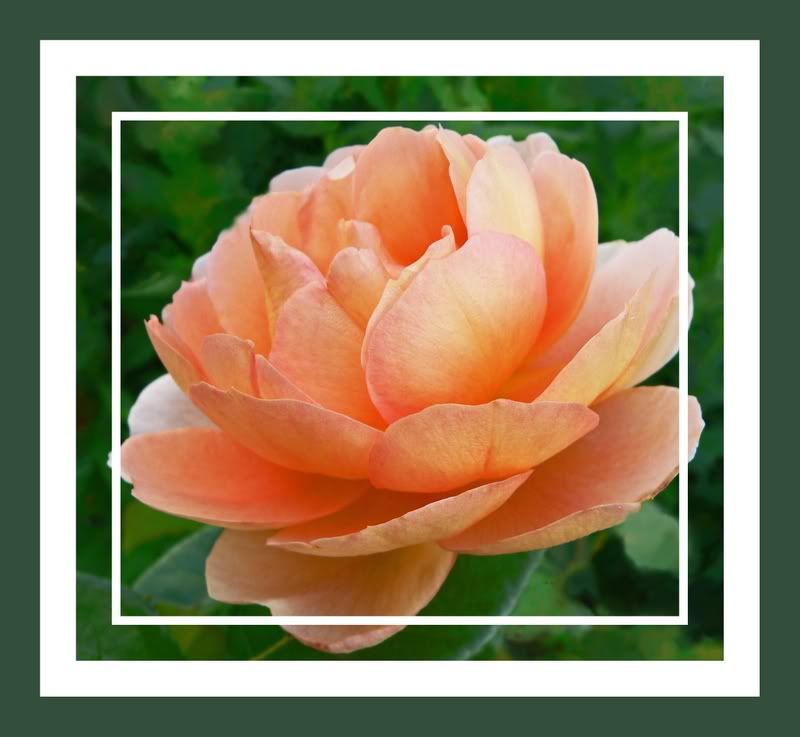
This one was run thru twice also.
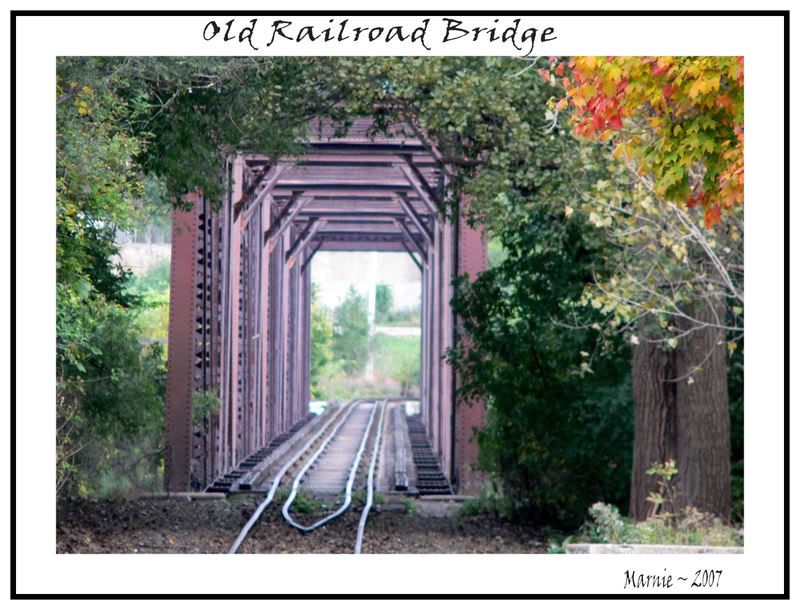
I don't remember how I did the one below. It was more complicated involving at least to separate frame/border combinations with shadow.
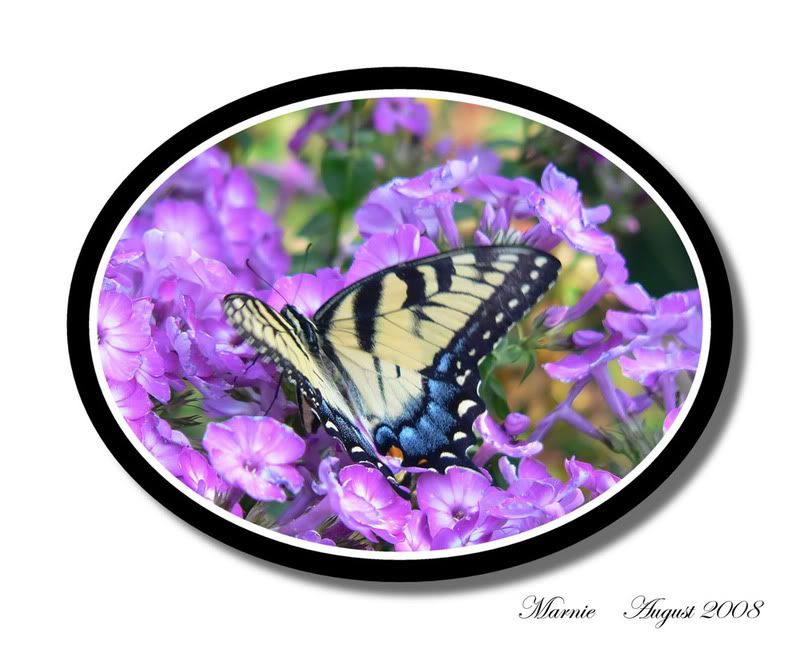
The secrete is just to jump in and try different combinations until you like the results. Trial and error is the best way to learn. There is a little instruction with the program but I never read instructions;)

Going back over the photos I uploaded, I see I chose black and white almost exclusively. There are endless other colors so don't be misled by my lack of immagination.

If anyone is interested in free photo editing programs that can attach text to your photos let me know.
Thursday, September 4, 2008

SkyWatch - A misty sunrise over an Illinois field

This is a SKYWATCH FRIDAY post. Click on the link to see some more beautiful skies.


Sunrise over a misty field in northern Illinois. I am truly blessed to wake up to this every morning.

Click the photo to enlarge.


I hope everyone has a wonderful weekend and gets to enjoy a spectacular sunrise.

Oh, by the way, check out Cielo's site House in the Roses. She is hosting a window party Monday September 8. If you have a window you like, email Cielo a photo (before the 8th) and she will post it on her 'Window Party' page. While you are visiting her site, be sure to click the garden door link. She has the cutest little animals waiting to welcome you and a fabulous garden of the month to tour.


Tuesday, September 2, 2008

Backyard birds

Goldfinches are one of the loveliest of our native birds. They are also one of the easiest to attract to your backyard.

In the late summer, goldfinches begin nesting and raising their young. One of the reasons they wait until so late in the season is because they use thistle down to line their nests and they feed their babies thistle seed. If you provide an easily accessible Nyjer thistle feeder sock, it will bring goldfinches into your garden. When the young are learning to fly, the parents will bring them to the thistle sock and teach them to eat on their own. This is one of the most rewarding times to sit back and enjoy wild birds outside your window.

Two weeks ago I had one thistle sock hanging outside my dining room window. The birds would empty it every two or three days. Now I have three socks and there are 4 or 5 finches on each sock all day long. Hungry finches are a rowdy, noisy crowd and their squabbling, and constant movement is an endless source of interest for both me and the house cats.

Most of the finch group is this season’s fledglings. At first they sit on a branch and loudly demand “Feedme me, feedme, feedme”. After a few minutes of watching the older birds they jump down onto a sock and get the hang of pulling the tiny seed thru the holes.

Nyjer seed is irradiated so it will not sprout in your yard and produce a crop of thistles. The seed that falls on the ground is quickly eaten by doves and other birds.Tips for buying, feeding and storing Nyjer thistle seed: Because it is expensive, you don’t want to waste the stuff, so here is what works best for me. I by a quality brand, usually Kaytee. It isn’t the most expensive but all Kaytee brand seed is excellent quality. Wild Birds Unltd also has good seed as do many independent stores. Nyjer is usually packaged in socks for easy feeding and in vacuumed sealed bags to save a little money. The birds seem to prefer eating from socks. (I used to fill thistle tube feeders and ended up throwing away a lot of uneaten seed. For whatever reason, goldfinches in my area just don’t like the thistle tubes.) I buy several socks pre-filled with seed and when they are empty it’s easy to wash the sock and refill from a 3- or 7- pound bag. Be sure to store the opened bag in a big airtight ziplock. Nyjer gets stale after opening and the finches will often refuse it once they decide it has been opened too long.

It may take the goldfinches several days to find your sock feeder. Don’t get too discouraged if they don’t show up right away. If the birds haven’t begun using the sock in a week or so, think about relocating it. There may be some reason the birds feel the location is unsafe. Consider hanging your sock from an ‘L’ bracket attached to your window frame. That brings the birds right up to your window for easy viewing and photographing. A shepherd's crook right outside the window works just as well. An interesting fact about birds and windows: A feeder located about 3 feet away from a window decreases the likelihood of a bird being injured or killed by hitting glass. Birds can't get up enough speed in 3 feet to do themselves much harm.
Many other bird varieties will also visit your sock to eat Nyjer including, purple finches, house finches, redpolls, indigo buntings, chickadees, and pine siskins.

And one other thing. A reminder to everyone who grows coneflowers, don’t be in a hurry to deadhead or tidy up the plants after bloom. Many native birds including finches, eat the seeds of this plant. Leave the dried stems standing until the birds have eaten the seed from the cones.

Wednesday, August 27, 2008

Salute to the American Worker

A salute to those who produce a product, provide a service, feed a family, and contribute to the strength and prosperity of our great country.
The vital force of labor [has] added materially to the highest standard of living and the greatest production the world has ever known and has brought us closer to the realization of our traditional ideals of economic and political democracy. It is appropriate, therefore, that the nation pay tribute on Labor Day to the creator of so much of the nation's strength, freedom, and leadership — the American worker. ~ U.S. D.O.L.

Everyone, please have a safe and enjoyable Labor Day weekend.

American Cranberry Bush

In the photo v. trilobum left growing beside v. opulus right.

Viburnum trilobum is a native American species often referred to as an American cranberry or highbush cranberry. Viburnum opulus is a non native sometimes called a snowball bush V. opulus has a spectacular May flower display but does not produce fruit.

The American cranberry is a fast growing shrub that can reach 12-15 feet high with equal width. Its May flowers are broad, white lacecaps rather than rounded. It has a graceful, airy appearance when in bloom.

Since the lower branches can become leafless and twiggy with age, I pune one of mine into a multi trunked, 15-foot shrub with lower trunks bare to about 3 feet, then branching densely. It can also be kept as a lower growing, more compact shrub maintaining foliage close to the ground. I use the latter pruning method to keep my second American cranberry more in scale with the shorter v. opulus planted beside it.

As its name implies, it produces abundant bright red fruit in late August and September. The fruit usually persists into the winter and is often still clinging to the bushes when the early migrating birds pass through the area. The fruit is safe for humans and is used in jelly. Burgundy red fall foliage provides some late season garden interest.
Depending on how it is pruned, it can create a quick growing hedge or screen. It is hardy in the northern U. S. and well into Canada.

I have experienced no pests or problems with this shrub. Although it is not recommended for drought areas, it has proved well able to handle our 2005 drought which was the areas worst in 75-years.


Tuesday, August 26, 2008

Walking on the wild side

We three went walking in the afternoon, the woman, Aggie the border collie and me, Toby the Tabby. We poke along and the woman takes pictures of flowers. A slow walk with lots of stopping and detouring off into the fields. This is the very best way to walk. Cats hate power walking.
The sun is low and my shadow stretches out in front of me.
We find white flowers twining along the lane.
As the lane begins to dip we stop to look at the graceful branches outlined in bright gold.
I rest a while and scratch my back on the bumpy pavement. Prrrrr, feels good.

A little farther on we find patches of wild sunflower reflecting back the remaining minutes of sunlight.
I show them the big puddle, dry now because no rain has fallen in all the month of August. Many tracks in the dried mud, deer, coyotes, raccoon, and mine. While it still held water, it was exciting to visit late at night.
We come upon a field of Queen Ann's lace as the sunlight fades. As the woman takes pictures, Aggie and I search for field mice.
We come home at twilight.

Aggie has some burs that have to be brushed out. Ouch, she says it hurts. Weeds don't stick to me;)

Friday, August 22, 2008

Flowers with wings

Every garden needs butterflies. Flowers with wings.

My father gave me a beautiful book on butterflies. Now I can identify most of the common varieties I see in my garden.
(Below a Monarch on red clover in my pasture. This butterfly migrates to Mexico during the winter months. Imagine the distance it fies.)Thou didst not know,
who tottered, wandering on high,
That fate had made thee for the pleasure of the wind,
With those great careless wings.
~ Robert Frost

(Below an Atlantis Fritillary on rudbeckia in my garden. The caterpillars feed on violets)On my walk today,
I saw a butterfly.
Delicate and free,
I watched it flutter by!
Flitting here and there,
to sample Nature’s best.
Constantly in motion-
determined in it’s quest
to find the sweetest nectar;
though it didn’t linger long.
Elusive, this must be,
for it paused for just a moment,
then was gone.
~ June Kellum

(Cabbage White Butterfly introduced to North America in 1860 it had spread throughout most of the US by 1886. This is one of the most common in my area. My salvia and agastache are alive with fluttering white wings.)
Butterfly Laughter
In the middle of our porridge plates

There was a blue butterfly painted

And each morning we tried who should reach the butterfly first.
Then the Grandmother said: "Do not eat the poor
butterfly."
That made us laugh.
Always she said it and always it started us laughing.
It seemed such a sweet little joke. I was certain that one fine morning
The butterfly would fly out of our plates,

Laughing the teeniest laugh in the world,
And perch on the Grandmother's lap.

~ Katherine Mansfield

(Tiger Swallowtail, exquisitely beautiful. The caterpillar feeds on the leaves of willow, cottonwood, wild cherry and poplar)

"You will be most successful if you remember

these simple rules: go slow, go low,

approach from behind, and don't cross

the butterfly with your shadow."

Butterflies do not believe in eclipses.

They believe in twilight and dusk and motion

as slow as the accumulation of dew and nectar.

They become very cross with uninvited gloom.

"Also avoid being silhouetted against the sky

in the butterfly's line of sight. If you keep low

against a background of trees or shrubs, you will be

less obvious to the insect." Elmer Fudd on tiptoe

to the tune of pizzicato ...

~ Tina Kelley

(A pair of Tiger Swallowtails nectaring on my Volcano Phlox--a very good reason to try one of these plants. )

(Another very common butterfly in my area is the Silver Spotted Skipper. It feeds on locust which are very prevalent. It seems to do best among houses and gardens where people live. It often flies close inspecting anything that comes into its range. This one enjoys the red clover in the pasture.

rocking gently on the waves...
of fairy wings and butterflies
to sleep, to dream of worlds
beyond the lights we see___
~Melanie Bishop

(Apologies for this poor photo. I don't see these Mourning Cloaks often and this one was very shy. Folklore legend says the larva of these butterflies is venomous--untrue of course. Mourning Cloaks are large butterflies with wingspans of over 3-inches. The adults feed on oak sap and occasionally rotting fruit. Most overwinter in this area.)
For information on butterfly gardens:
University of Illinois

May the wings of the butterfly kiss the sun.
And find your shoulder to light on.
To bring you luck, happiness and riches.
Today, tomorrow and beyond.
~ Traditional Irish

Tuesday, August 19, 2008

It's peony time

Not bloom time of course, but time to get out your catalogs and decide which ones you want to add to your peony collection. The best time for planting or transplanting peonies is September. If you order now, you will receive your plants at about the correct time for planting.

Peonies bloom at slightly different times so it is possible to extend your season by ordering early, mid and late season bloomers. Also, watch for tall and short varieties (21" to 40") and ones described as having very sturdy stems. Just to be on the safe side, order a peony cage too. That will guarantee your plant will stand up straight and not allow the heavy blooms to fall over and be ruined. Cages also prevent dogs and kids from running over newly planted bushes.

Once planted, peonies can live for a century. They aren't happy about being moved or divided, although transplanting can usually be done successfully if you are careful about weather and planting depth. Choose a site that is well drained, amend your soil with well rotted compost, and be sure not to plant them too deep.

A word of caution. Check out Garden Watchdog before ordering from any online vendor you don't know.

I'm looking at A&D's website. They have a nice selection in the $20 to $30 range, 3-5 eyes.
Khlem Song Sparrow has a good reputation for quality plants at $20 to $50, 3- 5 eyes. Newer hybrids, I didn't see many of the old standbys. Do order their wonderful catalog!
Gilbert H. Wild and Son has peonies in the $6 to $20 price range 3-5 eyes. Mostly old fashioned and more common varieties.
(I've ordered from Khlem and Wild in the past but have never bought from A&D Nursery.)

I'm trying to decide among these:

Mons. Jules Elie a medium pink double, fragrant of course:)

Mrs. F. D. Roosevelt said to be a classic. Many very fragrant, soft pink blooms per stem. Long outer petals overlapping a rosebud center. Gold Medal winner. An early bloomer. I'm almost certain this is one I will order.

Sarah Bernhardt (A&D Nursery Photo) possibly the best known pink peony. I have one of these but would like another for a different location. Sarah is a late bloomer.
Salmon Glory(A&D Nursery Photo)
Paul Wild(A&D Nursery Photo) fragrance is harder to find in red peonies than in other colors. I really like the looks of this red.
I keep looking at Bowl of Beauty. It is an elegant peony, but the doubles or bombs are my favorites.


Sorbet is a combination of pink and cream. Very full. No mention of fragrance so I may pass on this one. (A Gilbert H. Wild photo)


I'm definitely geting this Edulis Superba, one of the most reliable. A very early dark pink with good fragrance. (Gilbert H Wild photo)


So, everybody, open your catalogs and let's decide.

Monday, August 18, 2008

Clematis

Some photos from earlier this summer.
Comtesse De Bouchaude covers a corner of my garage. This clematis is a strong grower for me. It repeats, but only very slightly.
I'm afraid I don't know the names of the two blues. Neither has as many flowers as the Comtesse but they are such a lovely shade of blue. They produce an occasional flower here and there after their big June flush. I love the silvery blue on this one. I would like to add a few more next spring.
I had hoped to add photos of my Sweet Autumn clematis. Unfortunately, it looks like I may be losing it this year. It self seeded in an unfortunate place--a crack between the garage and the sidewalk. I imagine it has depleted the soil under the walkway. I hate to lose it. In late summer it transforms into a fairytail vine covered with small white stars and a heavenly scent that hangs in the air on warm evenings.

Thursday, August 14, 2008

What is wrong with this wren?


Don't be alarmed. He isn't sick or injured. This photo is just for fun.


Has he been partying all night?
Is he staggering home at dawn with a terrible hangover?
Is he crying?
Has his wife just thrown him out.
Are the kids driving him nuts?
Does he have the worst headache ever?
Did his girlfriend dump him for a more stud-ly wren?


Probably none of the above. He was scratching his head on the rough bark of that limb when
I caught him with the camera. Actually, I think he is enjoying a good scratch. You have to admit he looks pretty silly. The photo just seemed to need a moral story to go along with it;)

Everyone please have a great weekend.

The homeless Chickadee

In mid April I noticed him in the wood pile. A tiny chickadee, busy popping up and down in the crevices between logs. He was there again the next day, working among the logs in the same spot as the day before.

I was curious so I walked over to see what the little chickadee was up to. The wood pile is only a couple feet high, just a few old logs I use as photography props. As I approached the log pile, the chickadee scrambled out of a hole in the top log. Scolding me with loud dee-dee-dee-dees, he flew into a nearby tree.

The chickadee had indeed been busy. He had hollowed out a hole in the soft part of a rotten log. He was building a house for a new family, but in a very dangerous place. The log he had chosen was accessible to raccoons, squirrels, and worst of all Toby the Terrible Tabby. It was certain the chickadee family would not have survived a week in that spot.

It broke my heart to destroy his hard work, but I shifted his log so that he couldn’t reach the hole. I hoped he would find another place high in the trees to make a new nest. Unfortunately, he didn’t do that. This little guy had no sense of danger or maybe just no common sense at all. He was so desperate to have a home, he was making some terrible decisions.

The next day he and the missus were in and out of a decorative log cabin birdhouse that hangs in an amalanchier tree outside the dining room window. In the 5 or more years that little decoration has hung there, no birds have been foolish enough to try to nest in it. This little house, although cute, has a gaping hole that would have allowed squirrels, raccoons and both the dreaded house sparrow and European starling easy entrance.

I could not bring myself to take another home away, but I couldn’t let him stay there and be killed by a house sparrow or a starling. So, off to the wild bird supply to pick up a nice cedar nest box. It took me a long time to get it ready, add a 1.25 hole reducer, and properly mount it on a pole. A handy man could have had this house up in half an hour. It took me 4 hours. That’s how clever I am with tools.

The next morning before sunrise, the little log cabin was whisked from sight into the garage. I was pretty sure the chickadees would find the new cedar house very quickly.

When I got home from work that evening, Chickadee and the missus were both excited, flying in and out of the new post mounted, absolutely safe, cedar dwelling. I had located the new house in a scenic spot with a view of three Austrian pine threes and a lovely rugosa rose.

I kept an eye on the pair as they furnished their new home with a deep layer of soft green moss. On top they laid a fluffy blanket of cat hair (donated by my house cats). When they finished, it was as cozy as it could be. One by one eggs appeared in the hollow of moss until there were five. Whenever I checked, Mrs Chickadee had covered her eggs with the warm layer of cat fur before leaving the box.
All the eggs hatched and Mom and Dad made endless trips to bring the tiny hatchlings back food. I was concerned toward the second week. The house wrens had arrived. House wrens have a horrible reputation for breaking eggs and killing the young of other birds. The hole reducer that had kept the sparrows from entering the new house would not stop a wren. Either good luck or good vigilance on the part of the chickadee parents prevented disaster and all the babies thrived and left the nest to begin their new lives.

So the story of the homeless chickadee has the best possible ending. I would like to believe the entire family will remain in the area visiting my feeders. Come next spring, I will be ready with more nest boxes in case any chickadees find themselves homeless.

For more information on helping cavity nesting birds here are two sites to check out:

Gardening for Wildlife

Sialis